
When searching the internet for cyclist training advice or even when reading the most popular cycling training books, you will soon realise there are a lot of conflicting thoughts about the most effective training strategies. The very traditional school of thought has always advised long hours on the bike with frequent tempo or fast-paced rides. Polarised training, or high-intensity interval training (HIT) has only recently become popular among endurance athletes.
A training mix between very hard & very easy.
Polarised training refers to the idea of a training mix between very hard and very easy. Although there are still debates as to which mode of training is more effective, a recent scientific study by Neal et al. (J Appl Physiol 114: 461–471, 2013) from the University of Stirling in Scotland seems to have finally settled this debate once and for all. This study is the most comprehensive and most well-designed of its kind and may finally be able to accurately answer our question as to which training model gives us the greatest gains.
The study by Neal et al. compared predominantly tempo training (moderate intensity) to high-intensity interval training (HIT) in a randomised cross-over study. This is the best study design to answer the question at hand. All participants in the study were well-trained cyclists and performed
- 6 weeks of HIT and
- 6 weeks of tempo training (in a randomised order)
These protocols were separated by a 4 week detraining period in order for performance measures to return to baseline.
The training load during the 6 weeks of either HIT or tempo training protocols was matched. Before and after each 6 week training block, all participants completed:
- 40km time trial
- peak power output test
- a test to measure high-intensity capacity.
Although performance improved following both training protocols, the HIT protocol outperformed the tempo training protocol on all performance measures.
What training did the polarised / HIT protocol entail?
The study ensured that during the HIT period, the participants completed 80% of their time at a low intensity and 20% of their time at high intensity. The high intensity time was accumulated while performing 6 x 4-minute intervals with 2-minute rest periods. During the rest periods participants either pedaled backwards or stopped pedaling altogether.
How do I apply this to my own training?
Excellent results can be achieved through following a polarised program on only approximately 7-8 hours per week. When training for 7 hours per week, it is recommended to spend approximately 60 – 90 minutes (20% of training time) training at a high intensity.
The table below outlines how to gauge your training intensity and defines the split required for polarised training. The heart rate zones refer to the heart rate zones we use following an incremental exercise test in our laboratory. You can however either use heart rate or rating of perceived exertion (RPE) to gauge your effort during the HIT training.
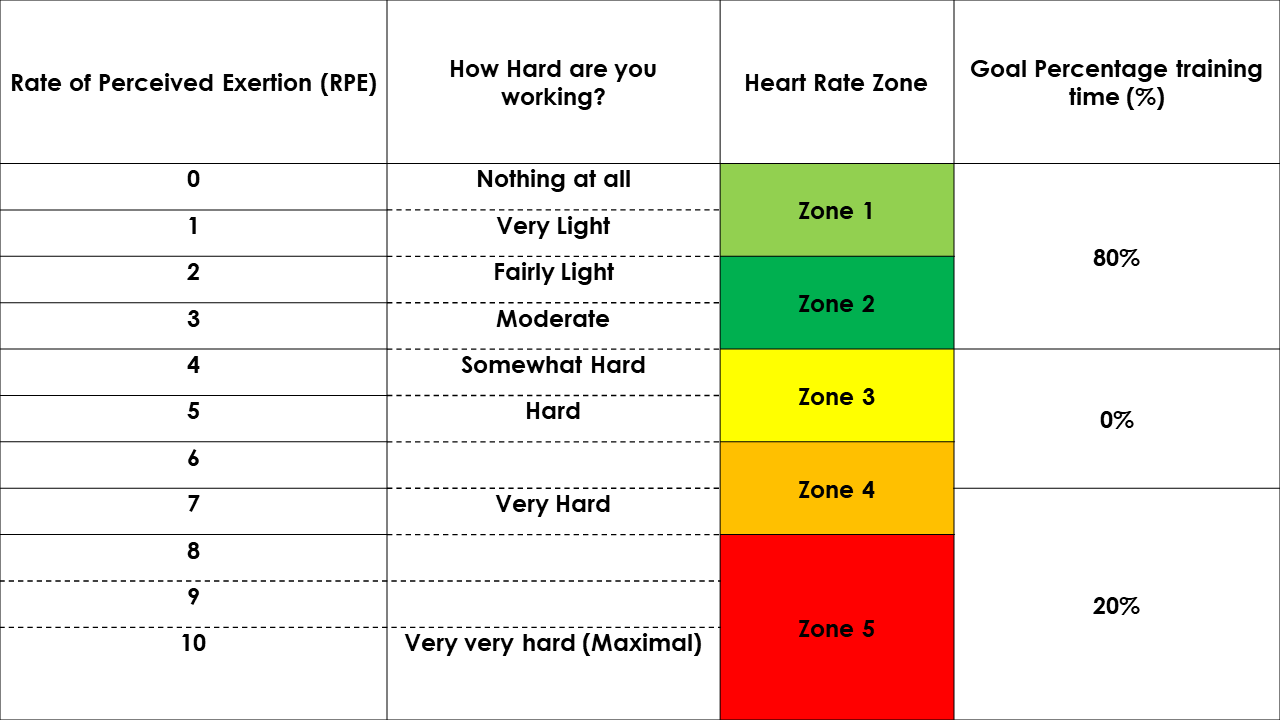
Completing intervals in zone 5 is as hard as you can possibly go for the allocated time, so a gauge to callibrate your effort is not as important as it would be for other types of training. If you could have gone harder you were in the wrong zone.
It is recommended to perform a maximum of two HIT sessions per week. Ensure you allow adequate recovery between sessions to lock in training progression (article).
Does this apply to me if I’m training to do the Cape Epic or other long stage races?
Most certainly yes.
The last 4-6 weeks prior to your event (excluding a taper) should include HIT. As shown in the study, polarised training resulted in far greater 40km time trial results compared to the tempo group. So even when measuring performance in longer performance tests closer to tempo / moderate intensity, the HIT protocol was still superior.
It is important to reduce total weekly training time when performing HIT.
Doing high-intensity training between long training rides will result in you becoming fatigued and not adapting optimally to the HIT.
You’ve made it to the end of the article! To learn more about training & coaching, sign up for our short online course: Cycling Science: the essentials of cycling physiology and coaching.