Bike fitting, or cycling biomechanics when referring to the scientific research and methods, is a rapidly evolving field with ever increasing numbers of tools at the fitters disposal. Despite this proliferation of technology, less than 15% of the tools available are validated scientifically for their accuracy and efficacy (whether they do what they say they do).
As such it is important to cover a few important concepts and dispel some misconceptions regarding bike fitting in general.
Pre-fit Assessment
Any good bike fit will start with an evaluation of the cyclist. How in-depth this evaluation becomes depends on the level of the bike fit (more in-depth assessments take longer and naturally cost more) as well as the expertise of the fitter. In many cases this may be a clinically trained individual such as a physiotherapist, biokineticist or sports medicine specialist.
A clinician is the appropriate choice to prevent future injuries or gain insight into possible causes of an existing injury. This is important as some problems may not be related to the bike at all. They could be due to “intrinsic factors” in the cyclist, such as leg length discrepancy, flexibility, posture and many other biomechanical factors.
During this assessment various measurements will also be taken. These will include stature, leg length, arm length and other measurements such as hamstring and spine flexibility tests. These are all necessary measurements as they provide the fitter with insight regarding the final position that the cyclist is likely to be able to adopt.
Predictive Fitting & Objective Measurement of Bike Parameters
Before asking the cyclist to climb onto the bike there are two important steps to bike fitting that should not be overlooked.
The first is a prediction of the optimal fit. The importance of this is not immediately obvious to most people seeking a bike fit.
An important starting point is that the fit should be conducted on the correct frame size. This is harder to achieve than it seems.
Most bicycle manufactures simply refer to a range in stature (height) and recommend specific frame sizes based on this.
However, this ignores two very important aspects.
The ratio of leg length, torso length and arm length.
Flexibility
Take two individuals of exactly the same height. One may have very long legs and a very short torso. The other may have the opposite i.e a very long torso and short legs and arms.
These two individuals may require frames that are up to two sizes apart.
The rider with long legs and short torso will likely require a smaller frame size as the distance to the handlebar (affected by frame size and stem length) needs to be shorter. The opposite applies to the rider with short legs and a long torso. They will require a larger frame size.
The next important factor is flexibility.
Once again consider two individuals but this time with identical arm and leg lengths. One may be exceptionally flexible and the other may be exceptionally stiff. The individual who is stiff may have reduced hamstring flexibility and reduced spine flexibility. This would require a lower saddle height and a shorter frame and handlebar reach.
The risk of buying the wrong size bike is very real and a common mistake to make.
Flexibility requirements are not evident from a simple height measurement. This could result in someone buying the wrong frame size.
Without a predetermined set of parameters it is not possible to choose the correct frame size to a high degree of accuracy. An incorrect frame size can be manipulated to create the impression that the bike fits, but there will be consequences such as compromised handling or sub-optimal muscle recruitment patterns.
A frame that is too big will never be optimal
For example, a frame that is too large can be adjusted to fit a rider by shortening the stem or reducing the saddle setback. However, this will result in reduced centre of mass over the front wheel, resulting in under-steer and the possibility that the front wheel will slide out in sharp turns or in wet conditions.
If adjusted by altering setback this may result in over recruitment of the quadriceps, placing them at risk of premature fatigue.
Pre-fit macro adjustments save time for perfecting the fit
Establishing the correct ratio between frame size, stem length and saddle setback prior to the fit will allow the fitter to achieve these macro adjustments speedily and once again save time so that this can be used on more nuanced areas of the fit to properly dial it in.
From the pre-fit evaluation the fitter will also have a set of information that will be useful in determining the correct
saddle height
saddle setback
handlebar reach
handlebar drop
With a very high level of experience a good fitter may be able to make a reasonably accurate estimate of the correct frame size and these parameters before checking the fit. However, it is possible to achieve a reasonably comfortable position with the incorrect ratios of these measurements and the cyclist would not be aware of this.
An example is setting the saddle higher than optimal but with less saddle setback. The saddle would be in the same effective saddle height and knee flexion angles would be similar. However, the more forward position would result in over-recruitment of the quadriceps and a position with the center of mass too far forward.
Similarly, using too much handlebar drop and not enough reach would provide a similar torso position but with too much lumbar flexion, resulting in a risk of lower back pain.
Position with excessive handlebar drop due to poor ratios of reach to drop.
Because there are numerous factors that influence this decision making process (as per some of the examples above) a computerised prediction of the optimal fitting makes this process dramatically easier, more accurate and faster.
At present, there is only one predictive system available that includes measurements of the various lengths of limbs and stature, as well as other factors such as flexibility, riding experience and others in predicting the optimal fitting. This is the ErgoFiT system developed by Science to Sport.
The second important step before asking the cyclist to climb on the bike is to accurately measure the initial position of the bike. This allows the fitter to record the initial position so that any changes can be recorded for reference once the fitting has been concluded.
Sometimes it may be necessary to reverse a specific change and without recording the initial position this becomes impossible.
Objective Measurements Are Critically Important
It is also very important to measure the bike parameters accurately. Many bike fittings are performed without objective measurements. Performing objective measurements requires a universal reference point.
The simplest reference point is the crank axle or bottom bracket. All measurements should therefore refer to their position relative to the crank axle. An example of a measurement which is not objective is measuring the distance from the tip of the saddle to the handlebar.
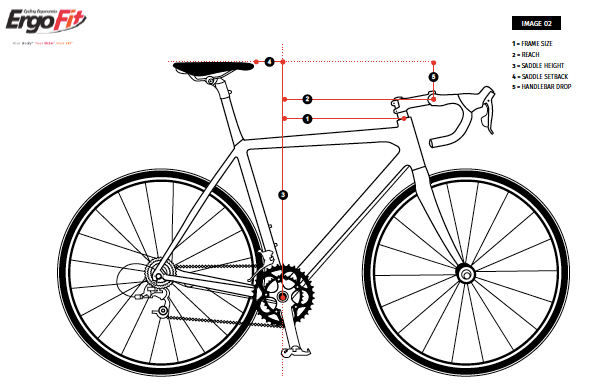
Two ways of performing objective measurements are highlighted in the diagrams below. The first uses a set of traditional measurements related to a line along the bike seat-tube. However, due to the advent of the 29er mountain-bikes, aero-bikes and other advances, many manufacturers are no longer creating bikes with seat-tubes set at 73-74 degrees.
This makes it impossible to perform traditional measurements without the use of a mechanical jig or a laser reference line. As such, we are advocating for a move to a very simple X-Y reference for all bike parameters. Some manufacturers such as Open bikes have already started referencing frame size in this way as opposed to the traditional measurement of horizontal top tube length.
Over time we hope that all bike fitters will move to this more objective and accurate measurement system which can be achieved by using a simple self-leveling cross hair laser available at most building supply stores.
Simplified X-Y measurements
Assessment of the Rider Position
Now it is time to finally ask the rider to mount the bike and to assess whether the fitting is optimal.
There are many ways and tools that are available to assess optimal fit. All of these have advantages and limitations. The fitter should ideally use multiple assessments and determine whether these are in agreement before making any alterations to the bike fitting.
There is a misnomer that the simple process of using a goniometer or digital inclinometer to evaluate the position of the cyclist while they are standing still and not pedalling (static kinematics) is somehow inferior to more expensive and difficult techniques such as dynamic 3D kinematics or 2D kinematics (the use of infrared markers or a camera to track movement while pedalling). However, recent research has shown that all of these methods have similar levels of accuracy, reliability and validity (they measure what they are supposed to measure)1.
Assessment while pedalling means taking the level of effort into consideration.
Dynamic measurements (assessment while pedalling) differ depending on the cyclist’s power output and therefore need to be assessed at a specific percentage of maximal heart rate or power output2. This may make these assessments less reliable if the fitter does not control for the power output during analysis.
Saddle Pressure Mapping
Of all the dynamic assessments, saddle pressure mapping provides the most practically relevant and meaningful data. This may seem counterintuitive but measuring saddle pressure provides a wealth of information about the center of pressure of the rider, as well as stability3. Measuring this data is quick, easy and readily interpretable. These variables provide feedback that guides saddle height, saddle setback and handlebar reach in an indirect but repeatable fashion.
Kinematics & Dynamic Whole Body Measurement
Unfortunately there is currently limited research to help guide the interpretation of dynamic whole body measurements such as 2D video kinematics or 3D kinematics. Going forward these techniques have a lot of promise. Especially newer systems which use enough markers to detect hip and shoulder position optimally and which are able to provide analyses without excessive time processing the data.
Bike fitters should be aware of the limitations of dynamic systems which do not measure hip and shoulder angle accurately due to the limited number of markers.
An example of a dynamic measuring system that neglects optimal hip, shoulder and spine assessment:
Markers on the spine are necessary to accurately measure:
hip angle
lumbar flexion
thoracic flexion
shoulder angle
Document the Final Bike Fit Position
After optimising and fine tuning the fitting, the consultant should re-measure the bike to accurately document the final position. Every bike fitting should be accompanied by a report that clearly provides the cyclist with feedback about the changes that have been implemented and documents the bike position in an accurate and objective fashion.
In summary:
there are numerous systems and tools available to guide bike fitting.
The fitter should use multiple independent tools as each tool or system has limitations.
The bike fit process should flow from:
pre-fit,
prediction of optimal fit,
accurate measurement of the bike before changes,
use of multiple tools to adjust and optimise the fit,
a final measurement of the optimised position.
References:
Holliday, W., J. Fisher, R. Theo and J. Swart (2017). “Static versus dynamic kinematics in cyclists: A comparison of goniometer, inclinometer and 3D motion capture.” Eur J Sport Sci17(9): 1129-1142.
Holliday, W., J. Fisher, R. Theo and J. Swart (2018). ” Cycling: Joint kinematics and muscle activity during differing intensities ” In review.
Holliday, W., J. Fisher, J. Salzwedel, R. McDonald and J. Swart (2018). ” The effects of relative cycling intensity on saddle pressure indexes ” In review.
About the Author
Prof Jeroen Swart
S2S Coach & Head of Performance, UAE Team Emirates XRG
Jeroen is a professor of Sports & Exercise Medicine and Exercise Science, and co-founder of Science to Sport. With over 50 peer-reviewed publications spanning cycling physiology, performance testing and sports medicine, he brings a rare combination of clinical depth and applied coaching experience to athlete development.
He has coached leading international cyclists for close to two decades, and as Head of Performance at UAE Team Emirates XRG — the UCI's number-one ranked WorldTour team from 2023 to 2025 — has worked with three different Tour de France winners. Jeroen is also the architect of the ErgoFiT predictive bike fitting system, the only scientifically validated tool of its kind.
Credentials & Background
MBChB, MPhil (SEM), ACSEM, FFIMS, PhD. A multi-time South African national champion in XCO mountain biking, Jeroen's own competitive background gives him a first-hand understanding of the demands elite cycling places on the body — and the ways it can break down.
Whether you're optimising performance for a specific race or building long-term aerobic capacity, our coaches design individualised programmes around your physiology, goals, and schedule.


.webp)