

In recent years, science behind fuelling and carbohydrate intake has changed a lot. Most of us are aware that we can absorb much more carbohydrate during endurance exercise than we previously thought. However, there are still many misconceptions around how to go about it.
Getting it right empowers you to get the most out of your training and racing. Getting it wrong can leave you suffering with gut issues and unable to perform. I’m going to cover some of the science around nutrition, and how to leverage it to optimally fuel your training and racing.
What Fuels the Engine?
The Physiology of Carbohydrate and Fat Oxidation
 During endurance exercise your body gets fuel from both fat and carbohydrate. The ratio of fat to carbohydrate that you burn depends on your efficiency as a rider, but generally at lower intensities your body uses more fat as fuel, and at higher intensities your body relies more heavily on carbohydrates.
Glycogen Stores Determine When You Bonk
Carbohydrates are stored as glycogen, in your liver and muscles. But stores are limited; they can sustain moderate exercise for about 2 hours. When these stores run out you “bonk” or “hit the wall” and performance is affected.
As glycogen levels get depleted during prolonged exercise, your body starts to govern your effort, causing you to feel fatigued, and unable to perform.
Train your body to use fat & carbohydrate optimally when racing
During training it’s important to teach your body to use both fat and carbohydrate as fuel. High intensity sessions are an opportunity to train your gut to absorb more carbohydrate to sustain higher intensity exercise for longer. Training with a low carbohydrate availability (fasted rides) can be used to increase the amount of fat you can oxidise.
Training Nutrition
How you fuel your training should be guided by two important questions:
- How important is performance in this session?
- Which energy system am I targeting?
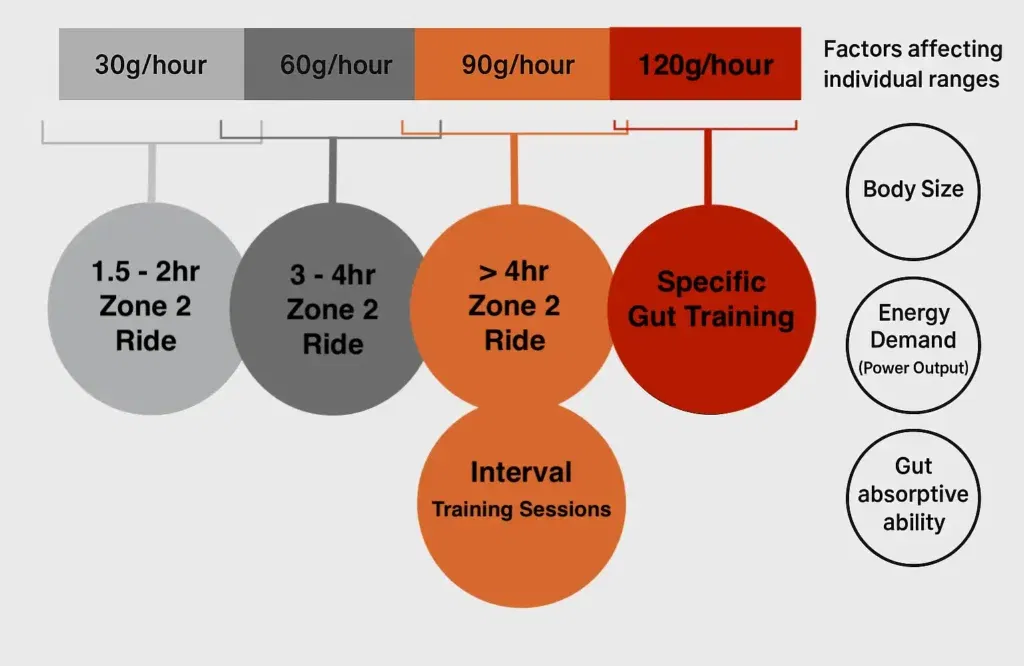
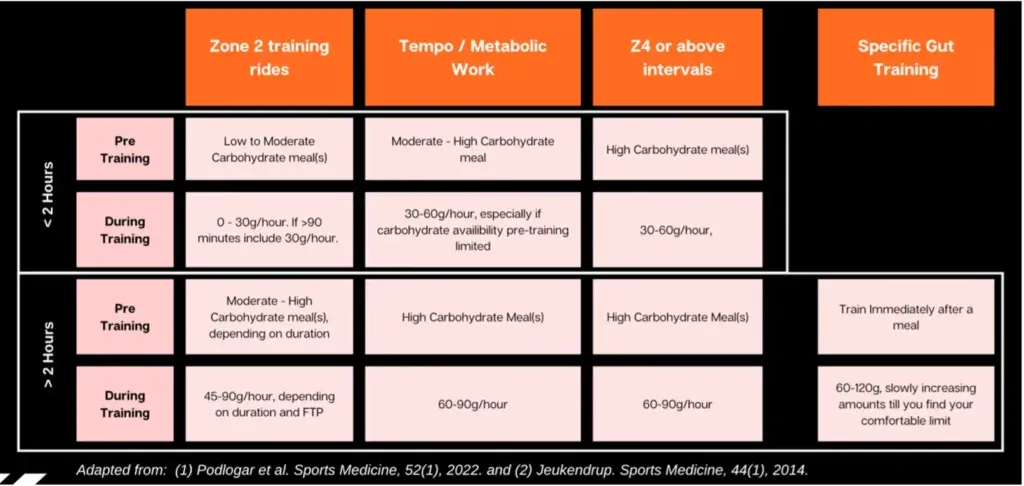
A Carbohydrate Feeding FrameworkShort recovery or zone 2 rides have lower fuelling needs. These can be done with 30g/hr of carbohydrate or less. Consider fuelling more if you have a key interval session the next day.
For high-intensity or key interval sessions, it’s essential to fuel adequately, both to support performance during the session and to optimise recovery and adaptation afterward.
These sessions also provide the ideal opportunity to train your gut. Use them to simulate your race-day fuelling strategy and
improve your ability to tolerate higher carbohydrate intakes.
Gut Training: The missing piece for many athletes
The ability to absorb carbohydrate during exercise is varies from athlete to athlete. Without specific gut training, most people can absorb around 60 grams of carbohydrate per hour. With gut training, most athletes can reach about 90g/hr with few gastrointestinal problems. Some athletes are able to reach 120g/hr or more.
If you are bloated, have stomach cramps, flatulance or diarrhoea after your rides, then you are probably not absorbing all the carbohydrate you consume.
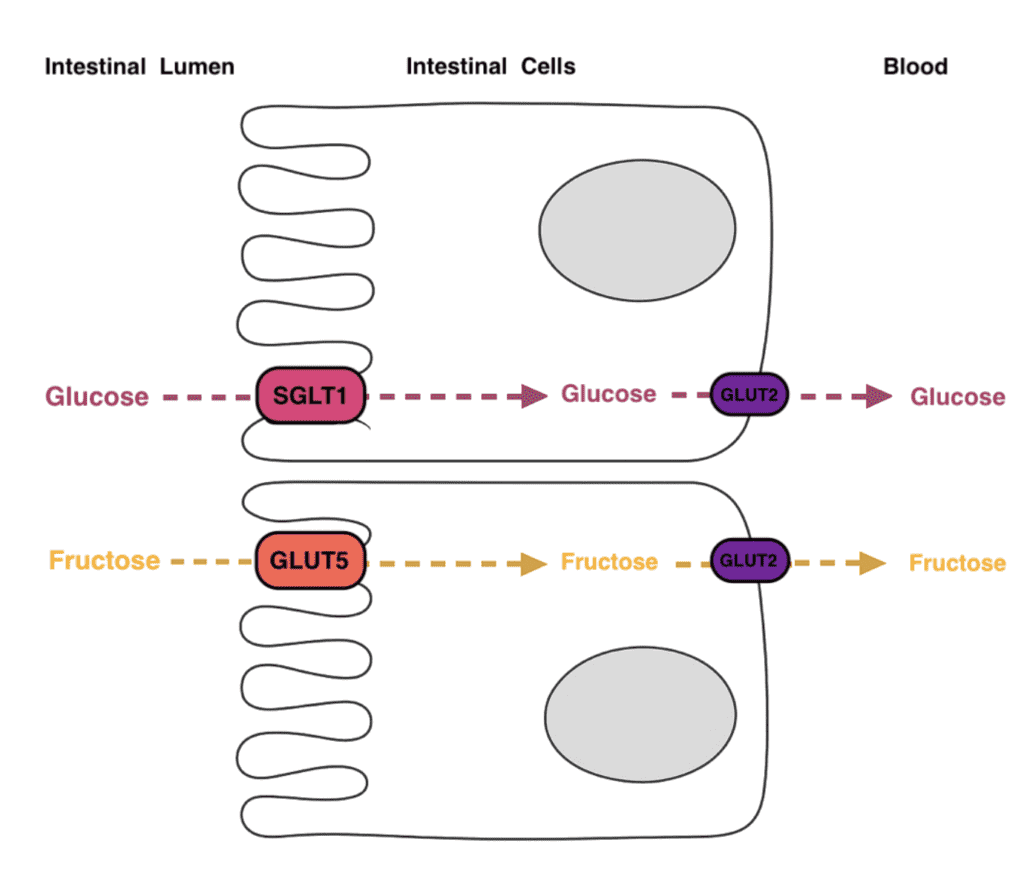 Carbohydrates come in different forms. Glucose and fructose are the ones relevant to sports nutrition. Each of these these is is absorbed by a different transporter.
Glucose is absorbed by a transporter called SGLT-1 (Sodium dependent Glucose Transporter 1). This transporter can absorb a maximum of about 60g of glucose per hour. If you consume more than this, then the transporter gets saturated and the glucose sits in your gut, potentially causing gut issues.
Fructose is absorbed by a transporter called GLUT-5. If you ingest both glucose and fructose, you can use both transporters at the same time, and absorb more carbohydrate per hour.
Train to absorb both glucose & fructose
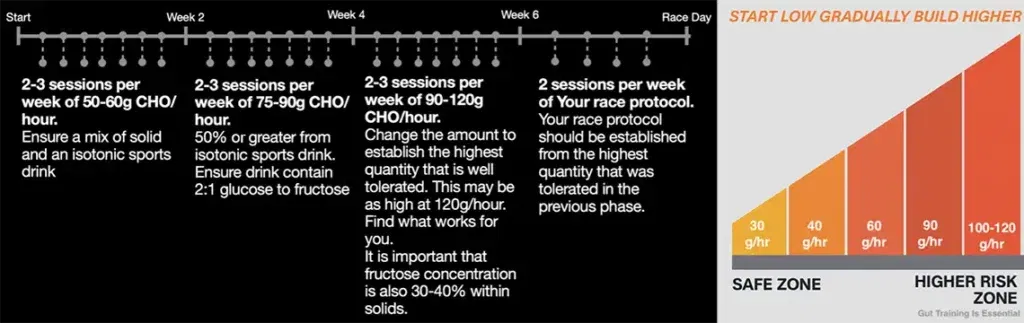
When training the gut, it’s best to consume both glucose and fructose, because adaptations are highly specific — increasing glucose intake improves glucose absorption but not fructose, and vice versa. To maximise carbohydrate absorption during exercise, both transport pathways must be trained through targeted intake.
A Gut Training Protocol
Carbohydrate Ratios
The ratio of glucose to fructose that you should consume depends on your personal tolerance. If you can tolerate 90g per hour, then you should aim for about 60g of glucose and 30g of fructose (2:1 Ratio). If you can tolerate 120g per hour, then you should increase the fructose you’re consuming and aim for 60g of glucose and
60g of fructose (1:1 Ratio).
Most nutrition products come in a 2:1 or 1:0.8 Glucose to Fructose ratio. Carbohydrate transporters and the way they absorb glucose and fructose are why you should look for brands with “multiple transportable carbohydrates” in their mixes.
This is also why adding maltodextrin or “pure carb” to your drink mix to increase the carbohydrate content doesn’t always work. Maltodextrin is glucose. And adding more glucose to a drink mix, is likely going to saturate those SGLT1 transporters, and the extra carbohydrate isn’t going to be absorbed.
Once you increase your carb intake beyond 60g per hour, you need to make sure your ratios are correct. Adding more glucose to your drink mix wont necessarily increase your carbohydrate absorption.
Drink Mix Concentration
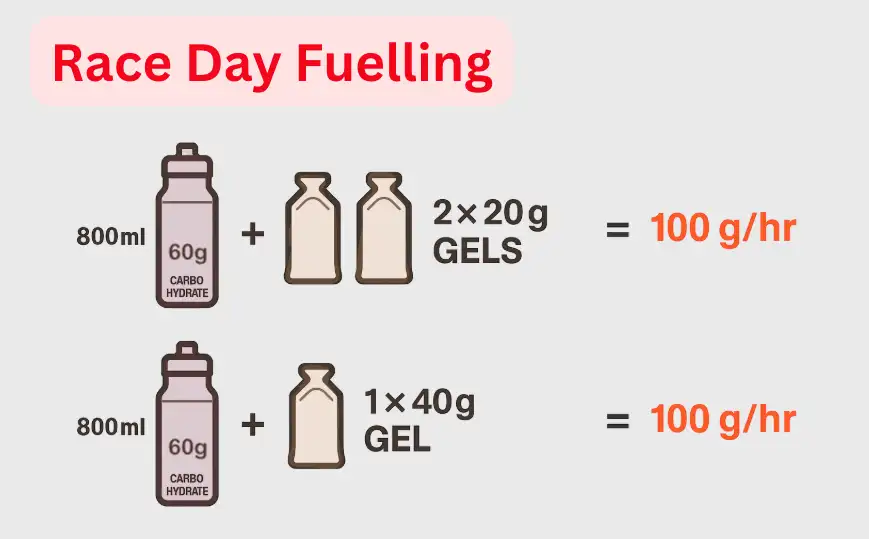
The optimal concentration of a drink mix to maximise absorption is 8%. Thats 60g in a 800ml bottle. Adding more carbohydrate creates a hypertonic solution, which may increase the risk of having gut issues, particularly if your gut is not trained to absorb higher concentrations.
Depending on environmental conditions, you could aim for about one 800ml bottle per hour. Top up the extra carbohydrate to reach 90-120g/hr by adding a gel, bar, chews etc.
A Periodised Approach to Gut Training
Fuelled rides during training are important to train your gut, but doing this for every session can blunt fat oxidation. Riding with low carbohydrate availability can improve fat oxidation, but doing too many sessions fasted can blunt CHO oxidation and reduce gut training effect. Therefore, a periodised approach to nutrition is best.
A Carbohydrate Feeding Framework
Race Day Nutrition Strategy
 The goal of fuelling in a race is to maximise your carbohydrate availability by starting with your glycogen stores fully topped up. During the race, the challenge is to consume enough carbohydrate to sustain your energy expenditure.
Race Day Breakfast
Overnight, your body uses glycogen to sustain all of your bodily processes while you sleep. This means that you wake up with your liver glycogen stores substantially reduced.
Liver glycogen depletion contributes to fatigue even before muscle glycogen runs out, so you want to start with this tank full. Top up your glycogen tank with a carbohydrate-based breakfast.
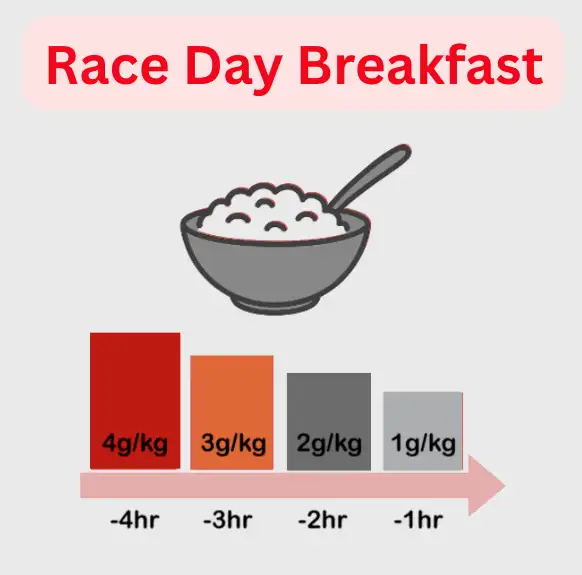
Timing: 1–4 hours before race
What to include:
- 1-4g carbohydrate/kg body weight.
- If you’re eating closer to start time, have a smaller meal (1g/kg)
- If you have more time before the start, then you can have a larger meal (4g/kg)
- Aim for low fibre, low fat carbohydrates.
- Stick to familiar foods.
Examples:
- Oats with banana and honey
- White rice with honey or syrup
- Bagel, Crumpets or Pancakes
- A liquid smoothie may be a good option if your struggle with eating on race day
As you do your final bike checks and warm up sip on a carb drink and have a snack.
Fuelling the Race
 Having a high carbohydrate availability during racing improves time to exhaustion, power output, and cognitive function, while reducing perceived effort and the risk of performance decline in the later stages.
Your targets on race day should depend on what you have been able to tolerate in training, how long the event is, and the environmental conditions.
General Targets
Aim for the maximum you can tolerate; this will depend on your previous experience with gut training.
If you consume:
- 60-90g/hr → 2:1 Ratio
- 90-120g/hr → use a 1:0.8 Ratio
Sources
- Carbohydrate drink mix
- Gels, chews, bars
- Real food like sandwiches, potatoes, muffins and dates can also be
used.
Strategy
- Use a mix of fluids and solids to reach your target.
- For example you could reach 90g/hour by dinking by drinking a 800ml bottle of carb mix along with a 20g gel every 30minutes.
Additional Tips
- Adjust your plan based on terrain, intensity and temperature.
- It may be useful to set a reminder on your head unit to remind you to eat.
- If racing a mountain bike race on single track, a hydration pack can make drinking easier. Its important to train with this to make sure your body is used to the weight.
- Coke is a great option to grab at water tables – it is an 8% solution
Recovery After the Race: The 60 Minute Window
 After your race you should be replenishing your glycogen stores and supporting muscle repair. Your muscles are primed to absorb carbohydrates in the first 60 minutes after you finish racing.
Using this window to refuel and rehydrate is particularly important during stage races.
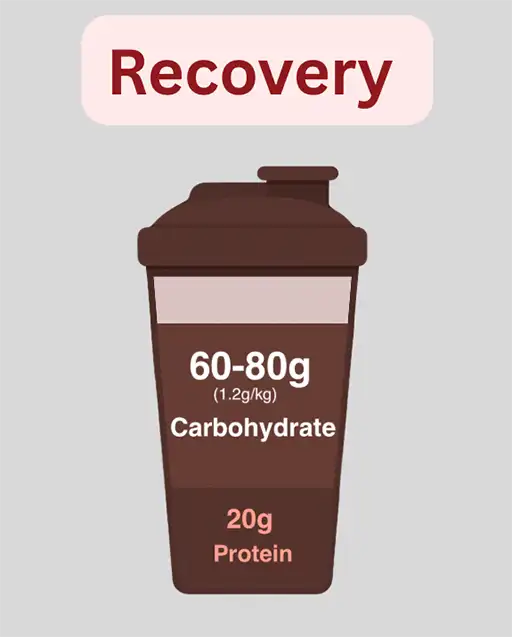
Aim to have about 60-80g (1g/kg) of carbohydrate which will go to replacing your glycogen stores. Add about 20g of protein which helps prevent muscle breakdown, and improves performance in subsequent rides. Rehydrate and replace electrolytes if its been hot.
Window: Within 30–60 minutes of finishing
General Targets:
- 60-80g carbohydrate
- 10–20g protein
- Plenty of fluids (especially if it was hot)
Examples:
- Chocolate milk + banana
- Recovery shake + sandwich
- Rice bowl with lean protein
Science to Strategy: Putting It All Together
Plan ahead:
- Know the race intensity and duration
- Have a fuelling target based on that
- Choose familiar products
Practice:
- Rehearse breakfast and in-race fuelling
- Use training races or long rides
Perform:
- Try to stick to your plan, but be flexible and adapt to race circumstances.
- Adjust for heat, altitude, nerves
Never Forget:
- Don’t overcomplicate it — carbs are king for racing
- Gut training is non-negotiable if you want to push 90–120g/hr
- Fuelling well isn’t just about avoiding bonking — it helps performance, cognition, and recovery